

Helichrysum Italicum Extract: Benefits and Uses
Helichrysum italicum extract is a botanical preparation made by extracting selected compounds from the flowers or other aerial parts of Helichrysum italicum with a solvent. In skincare, the extract may contribute antioxidant, soothing, and skin-conditioning properties as part of a complete cosmetic formula.
However, Helichrysum italicum extract is not a chemically fixed ingredient. Its composition varies by plant material, plant part, solvent, and extraction method. It should also not be treated as interchangeable with Helichrysum essential oil, which represents a different fraction of the plant.
This guide explains what Helichrysum italicum extract is, how extraction affects its composition, which compounds researchers have identified, what its studied properties may mean for skincare, and how Helichrysum appears within Sarda Zone formulations.
For the wider story of the plant, including its Sardinian heritage and different preparations, read about Helichrysum.
What Is Helichrysum Italicum Extract?
Helichrysum italicum extract is a preparation derived from Helichrysum italicum, a Mediterranean flowering plant in the Asteraceae family. The plant is also commonly known as immortelle or everlasting.
On a cosmetic ingredient label, a flower-derived preparation may appear as Helichrysum Italicum Flower Extract. COSMILE Europe describes this ingredient as a solvent extract of the flowers and lists its cosmetic function as perfuming.
The term “extract,” however, does not describe one universal chemical composition. Different extraction processes collect different groups and concentrations of plant constituents. Understanding the extraction method is therefore important when interpreting research or evaluating the role of a particular Helichrysum ingredient.
How Is Helichrysum Italicum Extract Made?
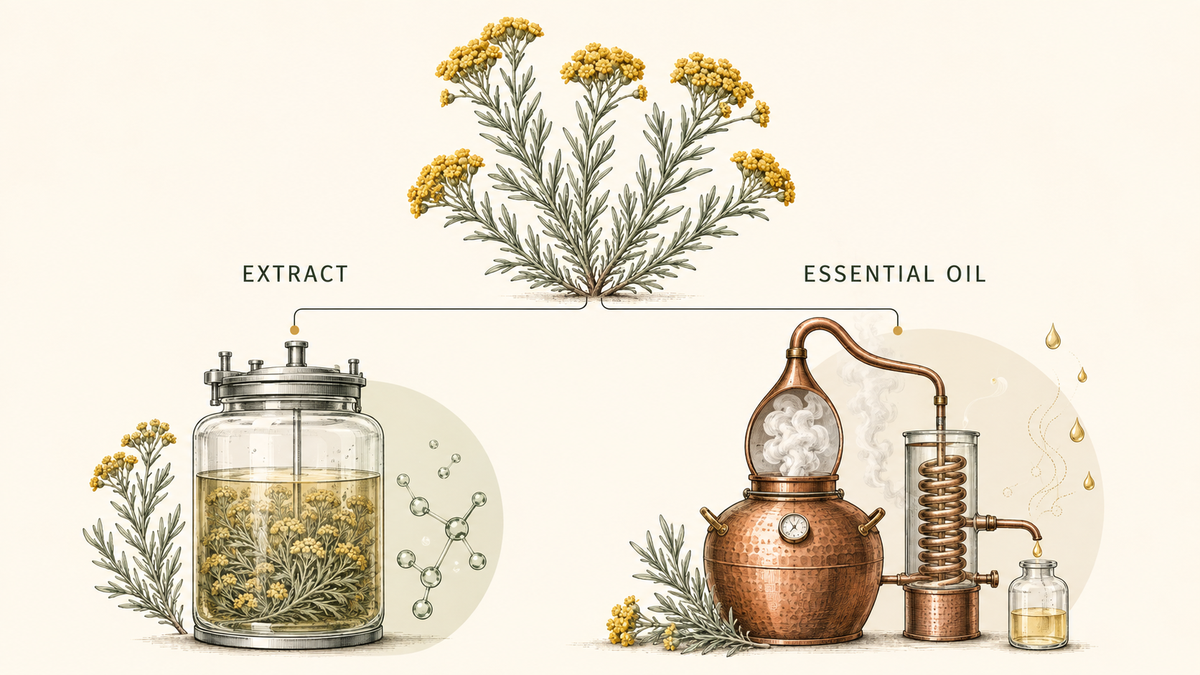
Helichrysum italicum extract is produced by bringing plant material into contact with a solvent that draws selected compounds from the plant.
Producers may use water, glycerin, ethanol, water-and-ethanol mixtures, or other extraction systems. They may also use flowers alone or broader aerial portions of the plant.
These choices influence the resulting chemical profile because compounds differ in their solubility and polarity. Water-based and hydroalcoholic preparations, for example, can extract polar phenolic compounds reported in H. italicum research.
Growing conditions, harvest stage, plant part, extraction parameters, and subsequent processing can create further variation.
For this reason, two ingredients described generally as “Helichrysum extract” should not automatically be assumed to contain the same compounds or concentrations. When exact composition matters, the specific INCI name and supplier documentation provide more useful information than the plant name alone.
Helichrysum Extract vs Helichrysum Essential Oil

Helichrysum italicum extract and Helichrysum essential oil are different preparations of the same plant.
Helichrysum essential oil is the volatile, aromatic fraction normally obtained through distillation. A solvent-derived extract can instead contain different groups of compounds depending on the solvent and extraction process.
Water-based and hydroalcoholic extracts tend to carry more polar phenolic compounds, whereas the essential oil contains a profile dominated by volatile molecules.
This distinction matters when interpreting ingredient research. Evidence about a phenolic-rich aqueous or hydroalcoholic extract cannot automatically be applied to Helichrysum essential oil, and findings about the essential oil should not be assumed to describe every flower extract.
Both preparations originate from Helichrysum italicum, but their extraction methods, chemical profiles, solubility, concentrations, and roles within cosmetic formulations can differ.
Which Compounds Are Found in Helichrysum Italicum Extract?
Helichrysum italicum extracts can contain flavonoids, phenolic acids, phloroglucinol derivatives, and other non-volatile constituents.
There is no single compound profile that applies to every commercial extract. The solvent, plant part, growing conditions, harvest stage, extraction process, and analytical method can all influence which compounds are detected and in what quantities.
Flavonoids
Flavonoids are among the plant compounds identified in non-volatile Helichrysum italicum preparations and are frequently studied in relation to antioxidant activity.
Reviews have reported compounds such as gnaphaliin, tiliroside, naringenin, and pinocembrin in particular H. italicum extracts.
These findings should not be interpreted as a guaranteed chemical checklist for every cosmetic ingredient labelled Helichrysum extract. They describe compounds identified in specific preparations under specific research conditions.
For consumers and formulators, the practical distinction is important: the ingredient name can identify the botanical source, but it does not necessarily reveal which flavonoids are present or their concentrations. Supplier specifications or certificates of analysis are more appropriate when precise composition is required.
Phenolic Compounds
Helichrysum italicum extracts can also contain phenolic compounds, particularly when extraction methods favour polar constituents.
Water and hydroalcoholic preparations have been reported to contain caffeic acid, chlorogenic acid, and related caffeoylquinic acids.
Phenolic-rich preparations are frequently associated with antioxidant activity in laboratory research. However, antioxidant activity measured in a chemical or laboratory assay is not equivalent to a demonstrated visible effect on human skin.
The findings instead provide part of the scientific rationale for using a characterized botanical extract in formulations intended to support skin exposed to everyday environmental stress.
Arzanol and Other Reported Constituents
Arzanol is one of the better-known non-volatile compounds associated with Helichrysum italicum.
It belongs to a class of compounds known as phloroglucinol alpha-pyrones and has been investigated in cell-based research involving inflammatory pathways. This mechanistic evidence can help researchers understand the biological activity of particular Helichrysum constituents, but it does not establish that a cosmetic containing Helichrysum extract treats inflammation.
Reviews have also reported acetophenones, tremetones, triterpenes, and other constituents in certain preparations.
By contrast, essential-oil markers such as neryl acetate and alpha-pinene belong primarily to the volatile fraction and should not be used as universal markers for every Helichrysum flower extract.
Why Does the Composition of Helichrysum Extract Vary?
The composition of Helichrysum italicum extract varies because botanical source and extraction conditions determine which plant constituents reach the final preparation.
Important variables include:
-
the part of the plant used;
-
geographical and growing conditions;
-
harvest stage;
-
extraction solvent;
-
extraction parameters; and
-
subsequent processing and standardization.
The most reliable interpretation therefore begins with the exact ingredient and preparation being used, rather than assuming that every study of H. italicum describes every cosmetic Helichrysum extract.
Properties of Helichrysum Italicum Extract
Helichrysum italicum extracts have demonstrated several biological activities in laboratory research, with antioxidant activity and effects on pathways associated with inflammatory responses receiving particular attention.
Most of this evidence remains preclinical. Chemical assays and cultured cells can help explain why an ingredient may be useful to formulators, but they cannot establish that every finished skincare product containing Helichrysum will produce the same effect on human skin.
Antioxidant Activity
Helichrysum italicum preparations have demonstrated antioxidant activity in laboratory studies, particularly preparations containing phenolic compounds.
Antioxidants interact with processes associated with oxidative stress. Skin experiences oxidative stress through normal metabolism as well as environmental exposure, which is why antioxidant ingredients are commonly considered when designing skincare formulations.
A characterized Helichrysum extract may therefore contribute antioxidant support within a complete formula.
The strength and practical significance of that contribution depend on factors including the specific extract, concentration, product stability, delivery system, and surrounding ingredients.
Laboratory antioxidant activity also does not demonstrate that a cosmetic prevents skin aging, reverses visible damage, or substitutes for sunscreen.
Soothing Potential
Certain Helichrysum compounds have been investigated in laboratory models involving inflammatory signaling pathways.
These findings provide a possible mechanistic basis for the plant's reputation as a soothing cosmetic ingredient. Within appropriate formulations, a suitable Helichrysum extract may contribute to skin comfort or help improve the appearance of stressed skin.
The distinction between soothing and treating inflammation is important.
Soothing is a cosmetic property related to how skin feels or appears. It does not establish that Helichrysum extract treats eczema, dermatitis, rosacea, or another medical condition.
Persistent skin symptoms should be assessed by an appropriately qualified healthcare professional.
What Does Helichrysum Italicum Extract Do in Skincare?
In skincare, Helichrysum italicum extract can contribute antioxidant, soothing, and skin-conditioning properties, depending on the specific extract and the complete formulation.
Its role should be evaluated as part of the finished product rather than in isolation.
Skin-Conditioning Benefits
Helichrysum extract can contribute to formulas designed to leave the skin feeling softer, smoother, comfortable, and cared for.
One cell-culture study using a concentrated aqueous H. italicum extract reported changes in genes associated with fibroblast and hyaluronic-acid biology.
However, the experiment was conducted using cultured human skin fibroblasts. It therefore provides mechanistic information rather than proof that applying a face cream or body cream containing Helichrysum extract will reproduce those effects in human skin.
This distinction is especially important when translating ingredient research into cosmetic benefits.
Its Role Within a Complete Skincare Formula
Helichrysum extract works alongside other ingredients rather than determining the performance of a skincare product by itself.
Different ingredient groups perform complementary functions. Humectants help attract and retain water, emollients help soften and smooth the skin surface, and occlusive ingredients can help reduce moisture loss.
A botanical extract may provide additional conditioning, antioxidant, or soothing properties within that system.
The meaningful unit for evaluating skincare performance is therefore the complete formula: its ingredient combination, concentrations, stability, delivery, texture, and compatibility with the individual user's skin.
Helichrysum Italicum Extract in Sarda Zone Skincare
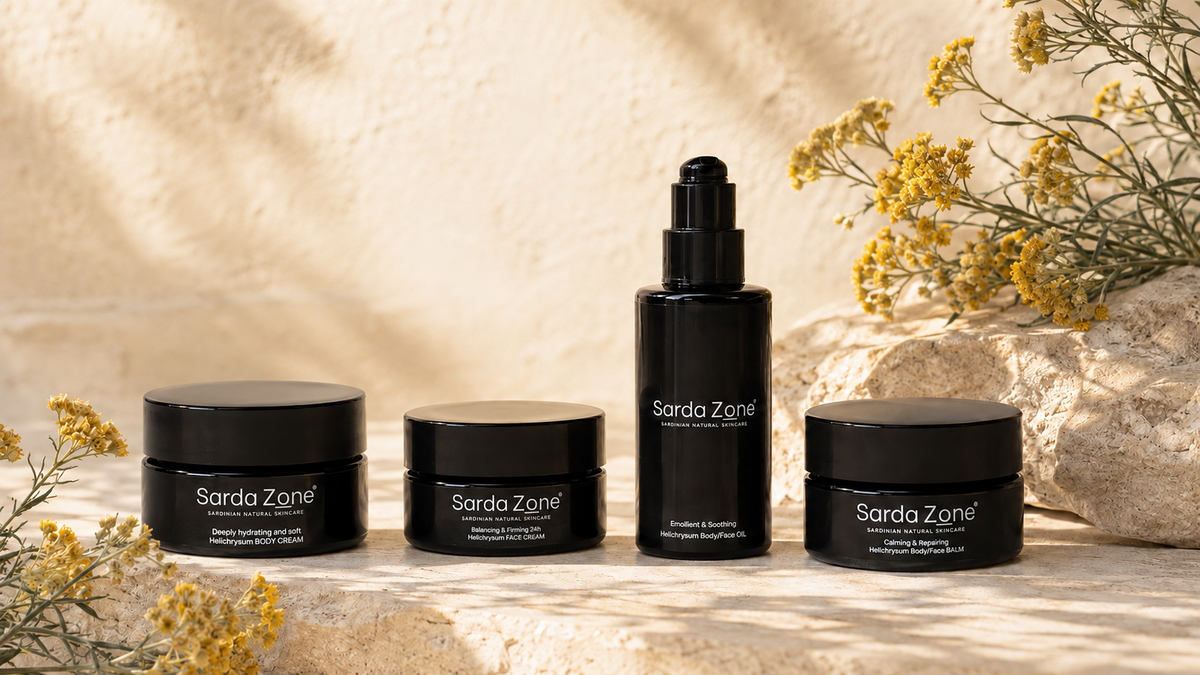
Helichrysum is at the heart of the Sarda Zone skincare line, which includes Helichrysum Body Cream, Helichrysum Body/Face Balm, Helichrysum Body/Face Oil, and Helichrysum Face Cream 24h.
These products bring Helichrysum into different formulation formats for face and body care, ranging from an oil and daily creams to a richer balm.
The form and function of Helichrysum should nevertheless be considered product by product.
For example, the Body Cream lists Helichrysum Italicum Flower Extract alongside humectants, plant oils, shea butter, squalane, and allantoin. The balm, oil, and face cream have their own ingredient systems and textures.
No single botanical ingredient explains the performance of the entire range. The complete INCI, concentration of individual ingredients, product stability, and supporting formulation determine how each product feels and functions on the skin.
Explore the Sarda Zone Helichrysum skincare collection to compare all four products and choose a format that fits your skincare routine.
Safety and Skin Tolerance
The suitability of Helichrysum skincare depends on the specific preparation, complete formula, and individual skin.
A botanical ingredient should not automatically be considered suitable for every skin type simply because it is plant-derived.
Follow the directions provided with the finished product and consider a patch test when introducing a new cosmetic, particularly if your skin is reactive or you have known sensitivities to plants in the Asteraceae family.
Anyone experiencing persistent irritation or symptoms associated with a skin condition should seek individualized advice from an appropriately qualified healthcare professional.
Summary
Helichrysum italicum extract is a solvent-derived botanical preparation whose chemical composition depends on the plant material and extraction process.
Studied extracts can contain flavonoids, phenolic acids, arzanol, and other non-volatile constituents. Laboratory research provides evidence of antioxidant activity and supports investigation of soothing and skin-conditioning applications, but direct human evidence for finished cosmetic products remains limited.
Helichrysum extract is also distinct from Helichrysum essential oil. The two preparations come from the same plant but differ in their extraction methods and chemical profiles, so evidence from one should not automatically be applied to the other.
In skincare, Helichrysum italicum extract is best understood as one functional botanical component within a complete, stable, and well-tolerated formulation.
Frequently Asked Questions
What does Helichrysum extract do in skincare?
Helichrysum extract may contribute antioxidant, soothing, and skin-conditioning properties within a skincare formula. Its effects depend on the specific extract, its concentration, and the other ingredients in the finished product.
Current research on Helichrysum extracts is largely laboratory-based, so the ingredient should not be described as treating irritation, repairing skin, or reversing skin aging based on this evidence alone.
What compounds are found in Helichrysum italicum extract?
Studied Helichrysum italicum extracts have contained flavonoids, phenolic acids, arzanol, and other non-volatile plant constituents. The exact composition varies according to the plant material, extraction solvent, growing conditions, harvest stage, and processing method.
An ingredient's INCI name alone therefore does not provide a complete chemical profile.
Is Helichrysum extract the same as Helichrysum essential oil?
No. Helichrysum extract and Helichrysum essential oil are different preparations.
Essential oil is the volatile aromatic fraction normally obtained through distillation. Solvent-derived extracts can contain different compounds, including more polar phenolic constituents depending on the extraction method. Their chemistry, solubility, concentrations, and formulation roles differ.
Is Helichrysum extract good for sensitive skin?
Helichrysum extract can be included in formulations designed to support skin comfort, but its presence does not automatically make a product suitable for sensitive skin.
Suitability depends on the complete formulation and individual sensitivity. Follow product directions and consider patch testing when introducing a new cosmetic, particularly if your skin is reactive or allergy-prone.
Does Helichrysum extract have antioxidant properties?
Laboratory studies have reported antioxidant activity in Helichrysum italicum preparations, particularly phenolic-rich extracts.
These findings support an antioxidant formulation rationale, but laboratory activity does not by itself demonstrate a visible anti-aging effect or prove the performance of a finished skincare product.
Why are Helichrysum extracts different from one another?
Helichrysum extracts can differ because producers may use different plant parts, solvents, extraction conditions, and processing methods. Growing conditions and harvest stage can also influence the plant's chemical profile.
For this reason, research on one specific Helichrysum extract should not automatically be generalized to every cosmetic ingredient made from the plant.
References
- Furlan V, Bren U. Helichrysum italicum: From Extraction, Distillation, and Encapsulation Techniques to Beneficial Health Effects. Plants. 2023.
- Kramberger K, et al. A Review and Evaluation of the Data Supporting Internal Use of Helichrysum italicum. Plants. 2021.
- Pekmezci E, Türkoğlu M. The Effects of Helichrysum italicum Extract on the Extracellular Matrix of the Skin. Acta Med Acad. 2023.
- COSMILE Europe. Helichrysum Italicum Flower Extract ingredient entry.

Leave a comment
This site is protected by hCaptcha and the hCaptcha Privacy Policy and Terms of Service apply.