

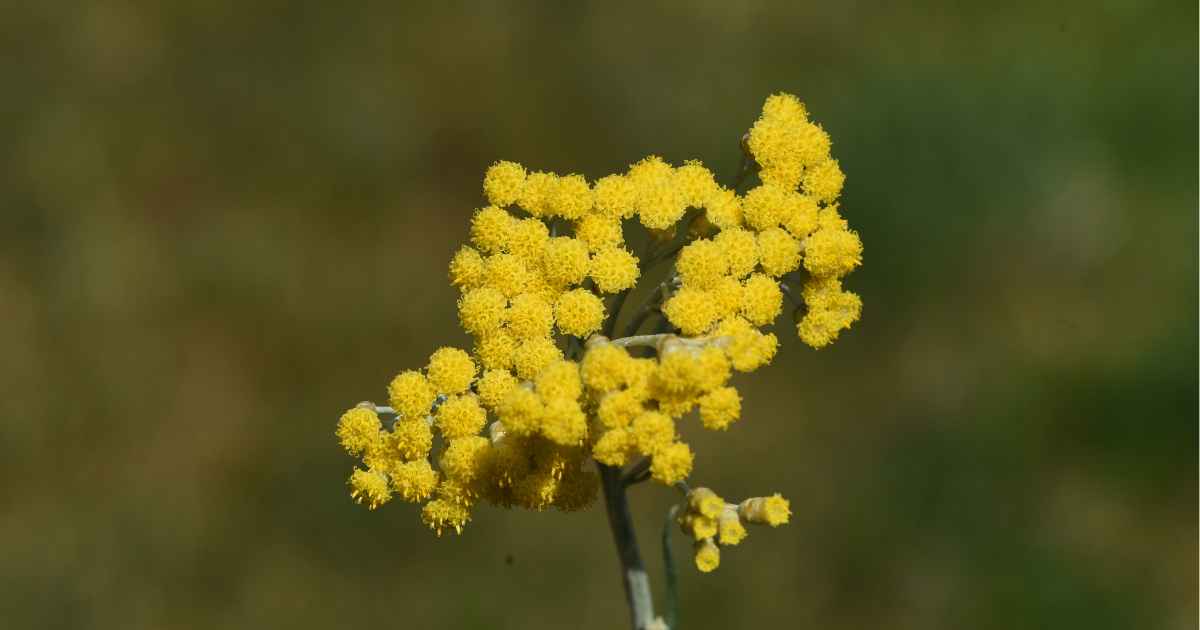
Helichrysum Italicum vs Gymnocephalum: Key Differences
Helichrysum italicum and Helichrysum gymnocephalum are different species, with different origins and essential-oil chemistry. Italicum is Mediterranean and associated with traditional skincare; gymnocephalum comes from Madagascar and often produces an essential oil rich in 1,8-cineole, also called eucalyptol.
If you are comparing skincare labels, that difference matters, but the species is only the first check. You also need to know whether you are looking at an essential oil, an extract, flower water, or a finished cosmetic formula.
At Sarda Zone, our connection begins with Helichrysum italicum and our founder’s Sardinian roots. Here is how to distinguish the two plants and choose a preparation that makes sense for your skin.
What is Helichrysum?
Helichrysum is a genus of flowering plants in the Asteraceae, or daisy, family. Helichrysum italicum and Helichrysum gymnocephalum are two distinct species within that genus.
They are not interchangeable names for the same plant.
In Sardinian skincare, Helichrysum usually refers to H. italicum, also known as immortelle. However, the word “Helichrysum” alone does not tell you which species or preparation a product contains.
For the wider botanical story, explore our guide about Helichrysum is. Here, we will focus on the differences that help you read a label and choose your next step.
Helichrysum italicum vs gymnocephalum at a glance
The clearest differences are their origins and essential-oil chemistry. A shared genus does not mean they offer the same experience or serve the same purpose.
|
Comparison |
Helichrysum italicum |
Helichrysum gymnocephalum |
|
Origin |
Mediterranean region, including Sardinia |
Madagascar |
|
Essential-oil chemistry |
Can include neryl acetate, alpha-pinene and gamma-curcumene; proportions vary |
Frequently dominated by 1,8-cineole; proportions vary |
|
Aromatic character |
Commonly described as warm, herbaceous and sometimes slightly sweet or curry-like |
Often associated with a fresher, eucalyptus-like character |
|
Context in this guide |
Sardinian skincare tradition and the botanical source used in our range |
A chemically different species encountered in essential-oil and aromatherapy contexts |
|
What to check before buying |
Whether the ingredient is an extract, flower water or essential oil, and the complete formula |
The exact species, intended use, and directions on the product |
The chemistry comparison describes essential oils. It is not a chemical specification for every extract, hydrosol, or finished skincare product made from either plant. Nor are italicum and gymnocephalum two chemotypes of one species: they are separate species. Chemical variation can also occur within a species.
What is Helichrysum italicum, and why do we use it?
For our founder, Giulia Siffu, Helichrysum was familiar long before it appeared on a skincare label. She grew up in Gallura, Sardinia, where the plant’s scent was part of the landscape, and botanical care was part of family life.
That connection stayed with her when she brought her skincare vision to Switzerland. It continues to shape our founder’s story and our interest in simple, thoughtful daily care.
Helichrysum italicum carries that sense of place. Its warm, herbal scent can recall the island itself, although aroma varies with the plant and its preparation.
For us, this heritage explains why we chose the botanical. The way each formula supports your routine depends on its ingredients, texture, and how your skin responds.
What does research tell us about its skincare potential?
Researchers have investigated H. italicum preparations and individual compounds for their relevance to skin biology. In one study, Corsican essential oil and neryl acetate affected markers associated with skin-barrier formation and increased lipids and ceramides in laboratory-maintained human skin tissue.
That is a useful scientific lead, but the experiment was not a clinical trial of a Sarda Zone product. It also does not establish that every Helichrysum preparation repairs sensitive skin or reduces bruising.
Our article on Helichrysum and sensitive skin explores the plant’s place in skin-comfort routines in more detail.
What makes Helichrysum gymnocephalum different?
Helichrysum gymnocephalum comes from Madagascar. Its essential oil has a different chemical emphasis: studies have identified 1,8-cineole as a major constituent. One analysis measured 47.4% in the sample tested, illustrating its prominence, though it did not define every batch.
This eucalyptus-associated compound helps explain why gymnocephalum appears in discussions of fresh, invigorating aromatic experiences. It offers a different aromatic direction from the warmer character commonly associated with italicum.
You may encounter claims about respiratory support or congestion when shopping for this oil. Its chemical profile alone does not prove that the whole oil treats those symptoms. Likewise, a refreshing scent does not demonstrate that an oil cleanses or disinfects skin.
For this comparison, the practical lesson is straightforward: do not substitute gymnocephalum for italicum and expect the same composition or skincare role.
Choosing for your skin starts with the preparation
Once you know the species, check what the product actually contains. An essential oil, a botanical extract, and a finished face oil can all carry the Helichrysum name while being very different products.
-
Essential oil is the concentrated, volatile aromatic fraction usually obtained by distillation.
-
Flower extract is a different preparation whose composition depends on the extraction process.
-
Flower water, or hydrosol, is the water-based fraction collected during distillation; it is not simply essential oil diluted in water.
- A finished skincare oil combines ingredients into a formula intended for the uses stated on its label.
Our guide to Helichrysum italicum extract explains this distinction more fully.
For example, our Helichrysum Body/Face Oil lists sweet almond oil, Helichrysum Italicum Flower Extract, and tocopherol, a form of vitamin E. It is a finished cosmetic oil, not a bottle of pure Helichrysum essential oil.
A practical label check is:
-
Read the full botanical name. “Helichrysum” alone is not enough to identify the species.
-
Find the preparation. Look for words such as Flower Extract, Flower Water or essential oil; ask the seller if the label is unclear.
-
Read the rest of the formula and its directions. These tell you whether it is intended for daily facial care and which other ingredients you will be applying.
A botanical name identifies an ingredient. It does not reveal its concentration, establish the batch's chemistry, or prove a finished product’s performance.
For dry or dehydrated skin, consider the whole formula
Choosing between two essential oils is not the same as choosing a moisturizer. Skin hydration depends on the complete formulation, including ingredients that help attract water, soften the skin, and limit moisture loss.
Our Helichrysum Face Cream 24h, for example, is formulated for dry, mature and dehydrated skin. Its ingredient list includes Helichrysum flower water and extract alongside glycerin, sodium hyaluronate, plant oils and squalane.
This is why we encourage you to consider the format as well as the botanical. A cream can provide your daily moisturizing step; an oil can add emollient richness when needed. Neither italicum nor gymnocephalum essential oil should be treated as a complete moisturizer.
For sensitive skin, make tolerance part of your decision
Neither species name guarantees that a product will suit sensitive skin. Natural ingredients can still cause irritation or allergy, and essential oils should not be applied undiluted to the skin.
Read the full ingredient list, follow the product directions, and introduce one new product at a time. Check a small area before wider use, and stop using a product that causes irritation. If you have a history of fragrance reactions, favor fragrance-free options and seek individual advice when needed.
For example, our Face Cream 24h lists Lavandula Oil/Extract, linalool and limonene, while our Body/Face Oil contains sweet almond oil. Check for ingredients you already know you react to, even when the botanical at the center of a product appeals to you.
The aim is to find care you can use comfortably and consistently. You do not need both Helichrysum species, or a homemade essential-oil blend, to build a daily skincare routine.
Bring Helichrysum into a routine that feels comfortable
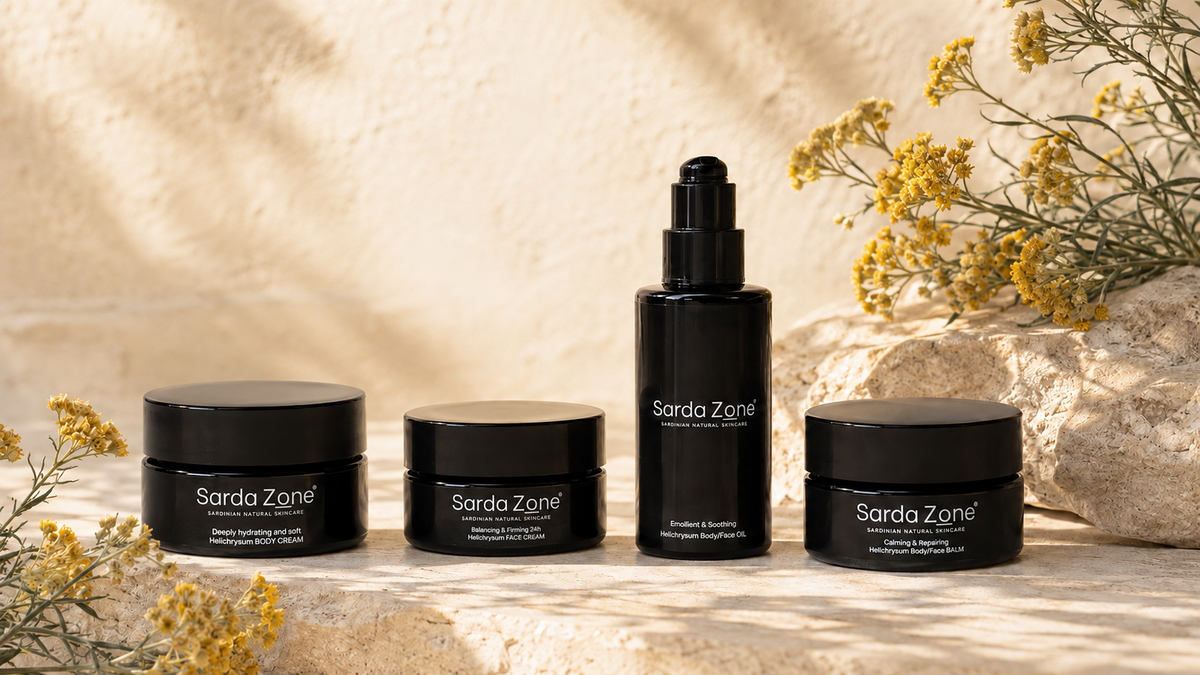
At Sarda Zone, we bring Helichrysum italicum into face and body care through different textures. Our Helichrysum skincare collection lets you explore creams, an oil, and a balm according to the care you are looking for.
Start with a moisturizing step that suits your skin. Add richness only where you need it, and give yourself time to see how each product feels.
For help choosing and combining textures, read the Helichrysum routine for sensitive skin. It explains how cream, oil, and balm can fit into a flexible daily ritual, with no need to use every layer every time.
References
- Tisserand Institute. Helichrysum: different species. Expert explanation of the species’ essential-oil profiles; not a comparative clinical trial.
- Afoulous S, et al. (2011). Helichrysum gymnocephalum Essential Oil: Chemical Composition and Cytotoxic, Antimalarial and Antioxidant Activities, Attribution of the Activity Origin by Correlations. Molecules, 16, 8273–8291. Chemical analysis and laboratory assays; no clinical evidence of respiratory or skincare benefits.
- Lemaire G, et al. (2023). Neryl acetate, the major component of Corsican Helichrysum italicum essential oil, mediates its biological activities on skin barrier. PLOS ONE, 18(3), e0268384. Skin-explant research, funded by Laboratoires M&L SA, Groupe L’Occitane; not a study of Sarda Zone formulas.
- American Academy of Dermatology. How to pick the right moisturizer for your skin.
- American Academy of Dermatology. Do facial masks work, and should I add one to my skin care routine? Guidance includes essential-oil irritation and allergy risks.


Leave a comment
This site is protected by hCaptcha and the hCaptcha Privacy Policy and Terms of Service apply.